Sentiens is my term for the universe of self-awareness: sentience, intelligence. Sentiens is a subset of Creatura, the universe of life.
Note that this taxonomy differs from the universe we inherit from past (and still-present philosophies, cosmologies, theologies. Our culture has to date accepted cosmologies in which sentience, God's, precedes life and awareness. In conventional Christianity the universe is a subset of God and God's awareness. In my present model, being developed here, all sentience is a subset of life, which is a subset of existence as we know it, which is a subset of time. Note further that I grant "objective" existence to Pleroma, grant that the organisms of Creatura have a Pleromic aspect — "bodies" — but insist that the fundamental reality of Sentiens is informational: symbolic: abstract: immaterial (intensional).
draft line
I say immediately that these qualities depend of semiotics: symbols, signs ... maps, models; and that anything that can symbolized can be symbolized well or ill. Thus, Sentiens necessarily represents a qualitative spectrum whose two poles I shall call Scientia and Dementia: the pole of accurate, intelligent, truthful modeling and the pole of erroneous, mistaken, un-sane symbol use.
Though the terms are mine, I follow Korzybski: all that is epistemology I class under Scientia; all else I class under Dementia. For example, Galileo, doing an experiment, participated in Scientia; the Church, the University, condemning him, participated in Dementia. Today, I, Paul Knatz, theorizing macroinformation, participate in Scientia; academic science and philosophy, the New York Times, not discussing it with me, participate in Dementia. The federal government, jailing and censoring me, participate in Dementia.
Thus Sentiens has a light side and a dark side.
Whether Pleroma has a Janus nature I am not ready to consider: but a minimally two-sided nature is likewise essential for an additional subset I propose with Creatura / Sentiens: Persona.
Creatura is made of of ecologies, environments, organisms. The macro-universe we inhabit has us seeing "things" in Pleroma we call stars, and galaxies ... The macro-universe which includes Creatura has us seeing "things" we call "individuals": this bacterium, that loon, this "person" "named" "Paul" ... We, the self-aware, call ourselves "human," attribute to ourselves "dignity," "intelligence" ... "rights" ... But this too has a dark side. We are social individuals: and no two societies agree on who has how much dignity, how many rights. The limits change over area: Mbutu was a "slave" in "Virginia"; Mbutu was "free" in "Ohio." The limits change over time: Mbutu was a "slave" in "1859"; Mbutu was "free" in "1869." "Women" were "property" in that "year"; "women" are "individuals" in this "year" ...
Notice: I use quote-marks to emphasize the wholly conceptual nature of the concepts suggested by the words. Pleroma may contain "things"; Sentiens contains only concepts and symbols. The informational universe is composed entirely of information.
There can be no "murder" in Pleroma. There can be no murder in Creatura except in that part of Creatura which is Sentiens: and which is also Persona.
Persona is the universe of "right": meaning that
Tuesday, March 17, 2009


Macroinformation and Things Spiritual
I suggest that the spiritual dimension of life and consciousness that has made people willing and even anxious to kill each other, rule each other, is actually a hitherto unarticulated sense of macroinformation: a confusion of Pleroma (energy / matter) and Creatura (organisms (energy / matter) stimulated by information: difference, probability, meta-difference ...
With a theory of Macroinformation, Hamlet doesn't have to be confused when he sees his father's "ghost"; Macbeth needn't run chill when he sees an eidetic dagger point the way to regicide. I don't need to be confused when God tells me this or that ...
With a theory of Macroinformation, Hamlet doesn't have to be confused when he sees his father's "ghost"; Macbeth needn't run chill when he sees an eidetic dagger point the way to regicide. I don't need to be confused when God tells me this or that ...
Monday, March 16, 2009
Number series
We're all familiar with our culture's ideas about space, we all have the basic vocabulary: There's length, width, depth ... Almost anyone can see that this can be expressed as a series: space1, space2 ...
or, dimension1, dimension2 ... Let's not get into the trouble the Christian calendar did though by starting with one: geeks these days start with that Arab invention, zero:space0
space1
space2 Einstein got people thinking of time as a fourth dimension. Hawking and others have followed suit thinking that time and space came into existence together, rejecting any idea that a God or anything else knowable by humans preceded space. Prigogine broke ranks, assuming that time is infinite. I join Prigogine's break of rank (scoffing at Hawking et alia): space came into existence within time. Space is mortal, time is not.
You may agree with this, disagree with that ... No matter what we agree or disagree on, I further assume that the truth will still be the truth, no matter what we think or say. (Mortals! While we've got the chance! To spew symbols!) Regardless, get this: these subnumber-series are handy, vivid ... They simplify, they teach.
Let's do spatial dimensions again, with a bit of care: First (that is, 0th), there's space0 (location), then there's space1, length (or width, or depth), then space2, width (or depth, or length), and then space3, depth (or length, or width) ... and then there's time.
Except according to Prigogine (as thought about by pk) time came before space, so it actually should go:space-1time
space0location
space1length
space2width
space3depth with plenty of room for Klein's (or Kaluza's) multiply-more dimensions: dimensions numbering eleven or twelve (since the early Twentieth Century!)
I first noticed how neat such series could be with Gregory Bateson's presentation of LearningN. Learning 0 represented a species' genetic or inherited intelligence: the insect knows how to grow its leg, its eye ... the insect knows how to move its wings ... Learning 1 for Bateson represented the kind of learning humans are so proud of, where baby learns to say "Ma," then "Mama," then "mother"; or we learn not to touch the hot stove again; or we learn anything not in our DNA which the phenotype may retain through life, possibly teaching the "thing" learned to family, friends, allies ... Now we know that Learning 1 is not unique to humans: the bird learns to hold a stick so that termites will grab the stick and the bird can then transfer them from the termite mound to it mandible, and from its mandible to its mouth ...
Learning 2 for Bateson was meta-learning, learning to learn: what geniuses do (in more than one species), what schools delude themselves to think they do. (Note: that latter point is Bateson's And mine; not just mine.)
So: here, theorizing Macroinformation, I apply Numberseries to levels of metainformation, drawing careful analogy with space; but now, further, I've also been presenting pk cosmology in exactly such a series: Existence0 ...
Note: when I say "category" I mean what previous philosophers mean, but also introduce new categories. When I say "level," such as in "logical level," I mean much the same thing. Ditto when I talk about sets and subsets. Read category, level, set ... as likely references meta-differences.
or, dimension1, dimension2 ...
space1
space2
You may agree with this, disagree with that ... No matter what we agree or disagree on, I further assume that the truth will still be the truth, no matter what we think or say. (Mortals! While we've got the chance! To spew symbols!) Regardless, get this: these subnumber-series are handy, vivid ... They simplify, they teach.
Let's do spatial dimensions again, with a bit of care: First (that is, 0th), there's space0 (location), then there's space1, length (or width, or depth), then space2, width (or depth, or length), and then space3, depth (or length, or width) ... and then there's time.
Except according to Prigogine (as thought about by pk) time came before space, so it actually should go:
space0
space1
space2
space3
I first noticed how neat such series could be with Gregory Bateson's presentation of LearningN. Learning 0 represented a species' genetic or inherited intelligence: the insect knows how to grow its leg, its eye ... the insect knows how to move its wings ... Learning 1 for Bateson represented the kind of learning humans are so proud of, where baby learns to say "Ma," then "Mama," then "mother"; or we learn not to touch the hot stove again; or we learn anything not in our DNA which the phenotype may retain through life, possibly teaching the "thing" learned to family, friends, allies ... Now we know that Learning 1 is not unique to humans: the bird learns to hold a stick so that termites will grab the stick and the bird can then transfer them from the termite mound to it mandible, and from its mandible to its mouth ...
Learning 2 for Bateson was meta-learning, learning to learn: what geniuses do (in more than one species), what schools delude themselves to think they do. (Note: that latter point is Bateson's And mine; not just mine.)
So: here, theorizing Macroinformation, I apply Numberseries to levels of metainformation, drawing careful analogy with space; but now, further, I've also been presenting pk cosmology in exactly such a series: Existence0 ...
Note: when I say "category" I mean what previous philosophers mean, but also introduce new categories. When I say "level," such as in "logical level," I mean much the same thing. Ditto when I talk about sets and subsets. Read category, level, set ... as likely references meta-differences.
Friday, March 13, 2009
Informational Cosmology
Informational Cosmology: Existential Categories
I defined macroinformation as complex information emerging from frictions among categories. I've given illustrations of grammatical frictions, usage frictions, logical frictions ... To go deep with me you must know something of my existential categories, sets and sub-sets. I name them, then introduce them:
Existence0Time (Prigogine's infinite time) Existence1Pleroma (the "physical" universe) Existence2Creatura (the universe of life) I further divide Creatura:Existence3Sentiens (the world of sentience) Existence4Persona (the world of self-dignifying informational entities) (from "man" to "god") The latter two categories are themselves complex, each having a negative pole. Sentient organisms use semiotic tools to model their experience and their ideas; but anything that can be usefully modeled can also be incorrectly modeled. At best Sentiens deserves the synonym Scientia; commonly a subset is better named Dementia, or, same idea, Pathologica.
Similarly, sentiences such as civilized humans dignify some individuals, bestowing Personhood on them. On the dark side, personhood can also be denied. Go to any prison and you will see some of civilization's rituals for stripping personhood. Some such distinctions we'll agree with: I don't agitate to extend the franchise to dogs; others any among us may disagree with: was Jesus really a felon? or a god?
Sentiens is a true and meaningful subset of Creatura; I acknowledge that my further dividing both Sentiens and Persona between their obverse side and a dark side is moot.
Earlier draft(s need the more revision):
Shannon (and Wiener) defined information in terms of probability. Bateson emphasized difference. Bateson also spoke of emergences at new levels of complexity, unpredictable from any component level. I wed all that into Macroinformation. Macroinformation is complex information which emerges from frictions among categories. Grammatical incompatibilities, such as Shakespeare's noun cluster "salad days," initiated my illustrations nearly half a century ago. Here I build my understanding of "categories" from the "ground" up.
Modern physics imagines time and space being born together. Theology had previously distinguished time from eternity: the world and time were evanescent; God's Eternity was, well, eternal. Ilya Prigogine assumes that time is infinite. I try to follow what Hawking is up to, I've always liked theology, but when it comes to "understanding" experience, I follow Prigogine: or try to. The shoes Bateson helped me put on help there too.
Understand: what I say here is NOT received wisdom. My understanding is incompatible with conventional understanding. To see my macroinformation you must see the difference between my macroinformation and conventionally understood information.
Categories
Once again, I'm talking about macroinformation emerging from friction among categories. Here I'm establishing what I mean by categories. A few basic existential distinctions are essential.
Gregory Bateson emphasized differences between the physical universe and the universe of life, chiding his fellow scientists for routinely confusing them. Predicting what will happen after you hit the cue ball is different from predicting what will happen after you hit the dog. I add a distinction within the universe of life: and find I must add a Prigoginean distinction before we even get to the physical universe: time. And with time I add a distinction I may wind up seeing as a synonym for time: existence: existence as potential. Before existence can exist it must be possible for existence to exist: before there can be information, there must be difference. Before there can be difference, difference must be possible. So: time is infinite, possibility exceeds actuality.
Theologians had one thing right: you can't go too far into any serious philosophy without bumping up against cosmology. pk information can't be understood without pk cosmology.
pk Cosmology: Time, Space ...
Originally there was time. Space came into being within time. Time is the set; space is a subset. Time is the set, the universe is a subset. Space and the universe cannot be separated. Time and the universe can be separated: though not in the time in which the universe exists.
When I talk about "existence," you may take it as current with time. Possible existence precedes actual existence. Alternate existences may exist long after actual existence ceases. If time is infinite, then so is potential existence.
This universe Gregory Bateson divides into two different categories of existence. He calls the physical universe Pleroma: the better to distinguish the universe of life, Creatura. Scientists of Pleroma talk with great confidence about predictability, Newtonian mechanics ... what the billiard ball will do when treated precisely, in precise conditions. Bateson studied the universe of life. I hit the cue ball, the 8 ball goes into the side pocket. If I hit the dog, the possibility referenced above, in the same way that I hit the cue ball, the dog may cringe, the dog may run, the dog may bite me. It's a different world, it needs a different science.
Shannon, sponsored by the phone company, developed his information science "in Pleroma." It's about characteristics of a signal transmitted over a wire. Wiener said that there's more "information" in a great poem than there is in the Manhattan phone book. Wiener's information took account of Creatura.
However Shannon was dealing with Pleroma, he was doing it in Creatura. We are humans, talking about our world. I follow Bateson, but find I must further divide Creatura, distinguishing among life, aware life, and self-aware life. (Note here that Bateson understood concepts such as "intelligence" and "learning" to apply more widely than merely to individuals. He found intelligence and learning in a red wood forest, in a sea coast, in a species, as well as in you and me. Me too: I follow Bateson very much there too.) I mark this further distinction with my term Sentiens: the universe of sentience.
Sentiens
Thus we have Time: or Existence0. And we have Existence1: Pleroma, the physical universe. (An alternate univere might have a universe with different characteristics, it might even not have a Pleroma!) Still in Bateson's universe, slightly modified, we have Existence2: Creatura, the universe of life. Now, pk cosmology: very much a Korzybskian, Batesonian, Prigogenean universe: I add Existence3: Sentiens: the universe of self-awareness. Qualitative differences can become quantitative; quantitative differences can become qualitative.
exploration and revision proceeding simultaneously
I defined macroinformation as complex information emerging from frictions among categories. I've given illustrations of grammatical frictions, usage frictions, logical frictions ... To go deep with me you must know something of my existential categories, sets and sub-sets. I name them, then introduce them:
Existence0
Similarly, sentiences such as civilized humans dignify some individuals, bestowing Personhood on them. On the dark side, personhood can also be denied. Go to any prison and you will see some of civilization's rituals for stripping personhood. Some such distinctions we'll agree with: I don't agitate to extend the franchise to dogs; others any among us may disagree with: was Jesus really a felon? or a god?
Sentiens is a true and meaningful subset of Creatura; I acknowledge that my further dividing both Sentiens and Persona between their obverse side and a dark side is moot.
Earlier draft(s need the more revision):
Shannon (and Wiener) defined information in terms of probability. Bateson emphasized difference. Bateson also spoke of emergences at new levels of complexity, unpredictable from any component level. I wed all that into Macroinformation. Macroinformation is complex information which emerges from frictions among categories. Grammatical incompatibilities, such as Shakespeare's noun cluster "salad days," initiated my illustrations nearly half a century ago. Here I build my understanding of "categories" from the "ground" up.
Modern physics imagines time and space being born together. Theology had previously distinguished time from eternity: the world and time were evanescent; God's Eternity was, well, eternal. Ilya Prigogine assumes that time is infinite. I try to follow what Hawking is up to, I've always liked theology, but when it comes to "understanding" experience, I follow Prigogine: or try to. The shoes Bateson helped me put on help there too.
Understand: what I say here is NOT received wisdom. My understanding is incompatible with conventional understanding. To see my macroinformation you must see the difference between my macroinformation and conventionally understood information.
Categories
Once again, I'm talking about macroinformation emerging from friction among categories. Here I'm establishing what I mean by categories. A few basic existential distinctions are essential.
Gregory Bateson emphasized differences between the physical universe and the universe of life, chiding his fellow scientists for routinely confusing them. Predicting what will happen after you hit the cue ball is different from predicting what will happen after you hit the dog. I add a distinction within the universe of life: and find I must add a Prigoginean distinction before we even get to the physical universe: time. And with time I add a distinction I may wind up seeing as a synonym for time: existence: existence as potential. Before existence can exist it must be possible for existence to exist: before there can be information, there must be difference. Before there can be difference, difference must be possible. So: time is infinite, possibility exceeds actuality.
Theologians had one thing right: you can't go too far into any serious philosophy without bumping up against cosmology. pk information can't be understood without pk cosmology.
pk Cosmology: Time, Space ...
Originally there was time. Space came into being within time. Time is the set; space is a subset. Time is the set, the universe is a subset. Space and the universe cannot be separated. Time and the universe can be separated: though not in the time in which the universe exists.
When I talk about "existence," you may take it as current with time. Possible existence precedes actual existence. Alternate existences may exist long after actual existence ceases. If time is infinite, then so is potential existence.
This universe Gregory Bateson divides into two different categories of existence. He calls the physical universe Pleroma: the better to distinguish the universe of life, Creatura. Scientists of Pleroma talk with great confidence about predictability, Newtonian mechanics ... what the billiard ball will do when treated precisely, in precise conditions. Bateson studied the universe of life. I hit the cue ball, the 8 ball goes into the side pocket. If I hit the dog, the possibility referenced above, in the same way that I hit the cue ball, the dog may cringe, the dog may run, the dog may bite me. It's a different world, it needs a different science.
Shannon, sponsored by the phone company, developed his information science "in Pleroma." It's about characteristics of a signal transmitted over a wire. Wiener said that there's more "information" in a great poem than there is in the Manhattan phone book. Wiener's information took account of Creatura.
However Shannon was dealing with Pleroma, he was doing it in Creatura. We are humans, talking about our world. I follow Bateson, but find I must further divide Creatura, distinguishing among life, aware life, and self-aware life. (Note here that Bateson understood concepts such as "intelligence" and "learning" to apply more widely than merely to individuals. He found intelligence and learning in a red wood forest, in a sea coast, in a species, as well as in you and me. Me too: I follow Bateson very much there too.) I mark this further distinction with my term Sentiens: the universe of sentience.
Sentiens
Thus we have Time: or Existence0. And we have Existence1: Pleroma, the physical universe. (An alternate univere might have a universe with different characteristics, it might even not have a Pleroma!) Still in Bateson's universe, slightly modified, we have Existence2: Creatura, the universe of life. Now, pk cosmology: very much a Korzybskian, Batesonian, Prigogenean universe: I add Existence3: Sentiens: the universe of self-awareness. Qualitative differences can become quantitative; quantitative differences can become qualitative.
exploration and revision proceeding simultaneously
Thursday, March 12, 2009
Existential Ambiguity
Existential Ambiguity
Sentiens simultaneously bears characteristics of its component worlds, Scientia and Dementia.
This will be hard to write, hard to conceive of let alone to clarify. Keep checking back for revisions (send money, offer servitude). The sub-worlds will be developed separately for convenience, but in truth they are inseparable.
Whether or not Time or Pleroma or Creatura, as wholes, have Janus-natures I leave unconsidered for the time being; but Sentiens (and its components) have infrangibly dual natures. Self-awareness, sentience, intelligence, while they function semiotically to symbolize our world and our experience, cannot be separated from the semiotic liability of error: from mistakes to unacknowledged lies.
Sentiens, the universe of sentient existence, self-awareness, intelligence has an irreducibly double nature. The semiotic potential that enables us to model our world necessarily also allows us to model it wrong. A map is of a different existential category than the territory – Creatura/Sentiens is not Pleroma – but also the map can be wrong: seriously wrong. Neither King Ferdinand's map nor Columbus's had the Americas between Spain and India, and Columbus's map had India much closer to Spain than it was.
That's clear to all, but what isn't obvious, is that our society has the same liabilities as the societies of the late Fifteenth Century. My existential sets, going hand in hand with my theory of Macroinformation (with its informational sets), models awareness as having simultaneous and indivisible capacities for both sanity and pathology. Thus, at its baptism, I draw Sentiens. Korzybski bade us become semantically sane, Bateson (and I) second the motion (while our academic colleagues can't conceive of the necessity), but Korzybski, Bateson, nor I can delete the capacity for error from our semiotic processing. Waves have crests and troughs, they can't be separated. Tides have highs and lows: and indeterminate borders (in time and space). Image making can serve survival; the same image making can prepare our doom.
Good. That's exactly as it "should" be. Informationally and existentially we live in a perfect universe: mortal.
Time is infinite. All of the universes I am tracing exist within time (there's no where else for them to exist) and are finite. Pleroma will have a death. Creatura will have a death. Sentiens will for sure. (It may be committing suicide right now.) (I'm laboring to help Sentiens endure and evolve into the distant future; my society labors to make sure that no one hears me.) (Leaving artists unpublished, sabotaging scientists, censoring philosophers is exactly what we say are will not do, while we do it, left and right.)
draft of 2009 03 12
Macroinformation issues from frictions among categories within the mind of a sentience. I say that all sentient existence has potential for friction built right in. I'm revising this series of posts to emphasize some irreducible double-nature for intelligence, for awareness. Either can help us survive, help us model our world, improve predictability: we'll trip over the roller-skate less often if we learn where things are likely to be located in our world: and our trippings will be even rarer if we can influence that order: "Judy, don't leave your skates on the front walkway." But our models of our world are not always true: did the sun really revolve around the earth? people said it did. Does the priest really know more about God than you do? The Church says he does.
Humans divide experience into "good" and "bad." Sometimes "bad" is elevated (or denigrated) to "evil." Our emotions consist of things we love and things we hate. Some groups succeed in getting others to listen when they insist that they can separate the good from the bad, that they can identify evil, that they can eradicate it. Watch out. I insist that there are binaries in our models of experience that cannot be separated. Intelligence may be sane: in general; intelligence may not be sane: absolutely. I see the skate, I avoid stepping on it: someone else, or me on some other occasion, may confront the skate, but "see" Lucifer incarnate, "hear" Mozart, "smell" my long deceased love ... How I react to such "seeings" may be well-adjusted, or may be more than a little pathological. This is true of All of us. The population can not be divided between the intelligent and the stupid, the good and the evil, though some authority can incarcerate some portion of the population in an asylum, it's "map" may not be a perfect fit for the territory.
I cannot overemphasize my point. I've been making it in one form or another all my adult life without being satisfied that I've been understood. I see myself as number N in a long line of teachers who still haven't been understood. Pythagoras' Theorem, Einstein's Relativity, may not be understood by the majority, or by my landlady, or by your grocer; but both concepts are understood by more than a couple of individuals. I see Alan Watts's understanding and teaching precede mine; but what core representatives of the civilization understand either of us? I can identify none.
Here's another analogy. Freud divided the self-aware between Eros and Thanatos; he didn't say "I'm for Life; You're for Death." No: both Eros and Thanatos are ineradicable in our psyches. Creation and destruction are inseparable. The wave cannot crest without also forming a trough.
Whatever we do as individuals, whatever we do as groups, whatever our institutions do serve intelligence, to promote awareness, to maximize sanity, we will still be subject to pathology. No matter how healthy we are, we will still be mortal: or we will no longer be human: not as we've meant "human" in the past.
But I suspect that Existence will be unable to separate some basic binaries even were the one sentient species that we know were to triple its intelligence and fine tune its sanity. In other words, I am expressing doubt, out loud, that even God, could be purely intelligent, and immune to insanity.
Sentiens simultaneously bears characteristics of its component worlds, Scientia and Dementia.
This will be hard to write, hard to conceive of let alone to clarify. Keep checking back for revisions (send money, offer servitude). The sub-worlds will be developed separately for convenience, but in truth they are inseparable.
Whether or not Time or Pleroma or Creatura, as wholes, have Janus-natures I leave unconsidered for the time being; but Sentiens (and its components) have infrangibly dual natures. Self-awareness, sentience, intelligence, while they function semiotically to symbolize our world and our experience, cannot be separated from the semiotic liability of error: from mistakes to unacknowledged lies.
Sentiens, the universe of sentient existence, self-awareness, intelligence has an irreducibly double nature. The semiotic potential that enables us to model our world necessarily also allows us to model it wrong. A map is of a different existential category than the territory – Creatura/Sentiens is not Pleroma – but also the map can be wrong: seriously wrong. Neither King Ferdinand's map nor Columbus's had the Americas between Spain and India, and Columbus's map had India much closer to Spain than it was.
That's clear to all, but what isn't obvious, is that our society has the same liabilities as the societies of the late Fifteenth Century. My existential sets, going hand in hand with my theory of Macroinformation (with its informational sets), models awareness as having simultaneous and indivisible capacities for both sanity and pathology. Thus, at its baptism, I draw Sentiens. Korzybski bade us become semantically sane, Bateson (and I) second the motion (while our academic colleagues can't conceive of the necessity), but Korzybski, Bateson, nor I can delete the capacity for error from our semiotic processing. Waves have crests and troughs, they can't be separated. Tides have highs and lows: and indeterminate borders (in time and space). Image making can serve survival; the same image making can prepare our doom.
Good. That's exactly as it "should" be. Informationally and existentially we live in a perfect universe: mortal.
Time is infinite. All of the universes I am tracing exist within time (there's no where else for them to exist) and are finite. Pleroma will have a death. Creatura will have a death. Sentiens will for sure. (It may be committing suicide right now.) (I'm laboring to help Sentiens endure and evolve into the distant future; my society labors to make sure that no one hears me.) (Leaving artists unpublished, sabotaging scientists, censoring philosophers is exactly what we say are will not do, while we do it, left and right.)
draft of 2009 03 12
Macroinformation issues from frictions among categories within the mind of a sentience. I say that all sentient existence has potential for friction built right in. I'm revising this series of posts to emphasize some irreducible double-nature for intelligence, for awareness. Either can help us survive, help us model our world, improve predictability: we'll trip over the roller-skate less often if we learn where things are likely to be located in our world: and our trippings will be even rarer if we can influence that order: "Judy, don't leave your skates on the front walkway." But our models of our world are not always true: did the sun really revolve around the earth? people said it did. Does the priest really know more about God than you do? The Church says he does.
Humans divide experience into "good" and "bad." Sometimes "bad" is elevated (or denigrated) to "evil." Our emotions consist of things we love and things we hate. Some groups succeed in getting others to listen when they insist that they can separate the good from the bad, that they can identify evil, that they can eradicate it. Watch out. I insist that there are binaries in our models of experience that cannot be separated. Intelligence may be sane: in general; intelligence may not be sane: absolutely. I see the skate, I avoid stepping on it: someone else, or me on some other occasion, may confront the skate, but "see" Lucifer incarnate, "hear" Mozart, "smell" my long deceased love ... How I react to such "seeings" may be well-adjusted, or may be more than a little pathological. This is true of All of us. The population can not be divided between the intelligent and the stupid, the good and the evil, though some authority can incarcerate some portion of the population in an asylum, it's "map" may not be a perfect fit for the territory.
I cannot overemphasize my point. I've been making it in one form or another all my adult life without being satisfied that I've been understood. I see myself as number N in a long line of teachers who still haven't been understood. Pythagoras' Theorem, Einstein's Relativity, may not be understood by the majority, or by my landlady, or by your grocer; but both concepts are understood by more than a couple of individuals. I see Alan Watts's understanding and teaching precede mine; but what core representatives of the civilization understand either of us? I can identify none.
Here's another analogy. Freud divided the self-aware between Eros and Thanatos; he didn't say "I'm for Life; You're for Death." No: both Eros and Thanatos are ineradicable in our psyches. Creation and destruction are inseparable. The wave cannot crest without also forming a trough.
Whatever we do as individuals, whatever we do as groups, whatever our institutions do serve intelligence, to promote awareness, to maximize sanity, we will still be subject to pathology. No matter how healthy we are, we will still be mortal: or we will no longer be human: not as we've meant "human" in the past.
But I suspect that Existence will be unable to separate some basic binaries even were the one sentient species that we know were to triple its intelligence and fine tune its sanity. In other words, I am expressing doubt, out loud, that even God, could be purely intelligent, and immune to insanity.
Graphics Montage
I made a few concept graphics a couple of years back:


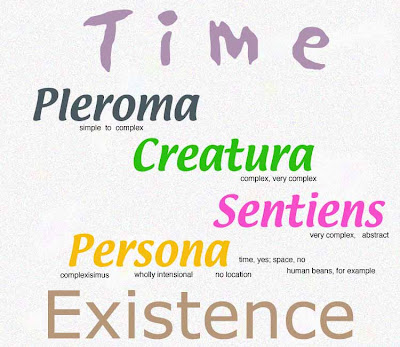
This latter graphic needs a bit of revision it's not likely to get any time soon: I'm re-conceiving Sentiens and Persona as quintessentially divided: between sanity and pathology, between affirmation of personhood and denial of personhood. (pk warns: pathology is as likely to call itself sanity, and put itself in charge, as the Christian Devil is likely to call himself an angel, or Christ, or God ... One year women aren't persons, another year gods aren't persons, another year this or that genius isn't a person ... Any year experts are sure to be as full of shit, as they are of knowledge (and any committee of experts is near sure to lack wisdom).


This latter graphic needs a bit of revision it's not likely to get any time soon: I'm re-conceiving Sentiens and Persona as quintessentially divided: between sanity and pathology, between affirmation of personhood and denial of personhood. (pk warns: pathology is as likely to call itself sanity, and put itself in charge, as the Christian Devil is likely to call himself an angel, or Christ, or God ... One year women aren't persons, another year gods aren't persons, another year this or that genius isn't a person ... Any year experts are sure to be as full of shit, as they are of knowledge (and any committee of experts is near sure to lack wisdom).
Tuesday, March 10, 2009
Existence as Sets
Gregory Bateson distinguished the physical universe, Pleroma, from Creatura, the world of life. If you hit the billiard ball with precision what it will do is predictable; if you hit the dog the dog may run, may cower, may turn and bite you ... It's a different "universe": especially with regard to predictability.
Sorting existence into responsible taxons is essential to my theory of Macroinformation. Think sets and subsets. Think categories. Think logical levels ... estates ...
I propose subsets for Bateson's Creatura: first, Sentiens, the universe of intelligence, and, not only awareness, self-awareness.
Sentiens: Pathologica / Santora
Right away I caution: there are ambiguities in sentience which I suspect are quintessential, ineradicable. Sentiens can strive for sanity, but is always at risk of pathology. Are we pruning error, or burning witches?
I welcome feedback on my coined names for these categories (as I welcome feedback on anything).
My current thinking requires substantial revision of recent posts on the subject.
Notice, in terms of predictability: classical physics had seemed cut and dried; Prigogine's thermodynamics brings Pleroma much closer to Creatura. I wish Bateson could have known the work.
Sorting existence into responsible taxons is essential to my theory of Macroinformation. Think sets and subsets. Think categories. Think logical levels ... estates ...
I propose subsets for Bateson's Creatura: first, Sentiens, the universe of intelligence, and, not only awareness, self-awareness.
Sentiens: Pathologica / Santora
Right away I caution: there are ambiguities in sentience which I suspect are quintessential, ineradicable. Sentiens can strive for sanity, but is always at risk of pathology. Are we pruning error, or burning witches?
I welcome feedback on my coined names for these categories (as I welcome feedback on anything).
My current thinking requires substantial revision of recent posts on the subject.
Notice, in terms of predictability: classical physics had seemed cut and dried; Prigogine's thermodynamics brings Pleroma much closer to Creatura. I wish Bateson could have known the work.
Thursday, March 05, 2009
Existence0
A moment ago I posted a comment that my numbering system here is based on Bateson's LearningN distinctions. He started his series with zero, so do I. Except that his Learning0 referred to learning as expressed by evolution in the species: the insect knows how to grow its leg, how to move its wings; the insect does not learn how to turn its nest into a duplex with a reinforced concrete terrace. There I differ in trying to adumbrate cosmological fundamentals. Thus my Information0 is not data, but the possibility of data.
In the midst of posting my series on InformationN it occurs to me to make an analogous series for Bateson's Pleroma / Creatura distinction, which I extend to the subset Sentiens and beyond.
Here I do start with zero, but make Bateson's Pleroma, the actual physical universe, Existence1. Existence0 I reserve for Ur-Existence: the possibility of Existence: the state in which a Singularity can occur. Perhaps that's Time.
Yes: I'll make that, perhaps temporarily, a "decision." Time is Existence0. Space coming into being, Pleroma, is Existence1. And Creatura is Existence2, Sentiens Existence3 ... Persona Existence4, Pathologica Existence5
Once again, what we say is map, not territory: except of course that all we say is in the "territory" of "maps"! Thus, we live by our models of the world. I revise my models the best I can: and offer my revisions for your consideration.
"god" "offers" us "salvation": survival; god does not force us to accept it.
Now, 2009 03 12, I notice a drawing of the concept I'd done at least by 2004.
So my "decision" isn't new after all. Beats your work to hell when you get arrested in the middle of it.
In the midst of posting my series on InformationN it occurs to me to make an analogous series for Bateson's Pleroma / Creatura distinction, which I extend to the subset Sentiens and beyond.
Here I do start with zero, but make Bateson's Pleroma, the actual physical universe, Existence1. Existence0 I reserve for Ur-Existence: the possibility of Existence: the state in which a Singularity can occur. Perhaps that's Time.
Yes: I'll make that, perhaps temporarily, a "decision." Time is Existence0. Space coming into being, Pleroma, is Existence1. And Creatura is Existence2, Sentiens Existence3 ... Persona Existence4, Pathologica Existence5
Once again, what we say is map, not territory: except of course that all we say is in the "territory" of "maps"! Thus, we live by our models of the world. I revise my models the best I can: and offer my revisions for your consideration.
"god" "offers" us "salvation": survival; god does not force us to accept it.
Now, 2009 03 12, I notice a drawing of the concept I'd done at least by 2004.
So my "decision" isn't new after all. Beats your work to hell when you get arrested in the middle of it.
Information4: Macroinformation
Information4macroinformation
metainformation more complex than both metadata and basic-natuaral-language-with-grammara product of metadifference Additional comments will follow.
metainformation more complex than both metadata and basic-natuaral-language-with-grammar
Information3: Metainformation
Information3metainformation one level beyond metadatagrammar, for example: where a noun functions differently than a verb Additional comments will follow.
Information2: Metadata
Information2metainformation of the simplest kindmetadata: information about the information Additional comments will follow.
Information1: Data
Information1any perceived difference
dataforeground / background
zero / one Additional comments will follow.
data
zero / one
Information0
Information0the possibility of perceived difference Energy frozen out as "matter" must be different in Pleroma, the physical universe, but (monotheistic theologians aside) it can only be perceived as different in Creatura, the universe of life, and, additionally, can only be understood as different in Sentiens, the word of sentience, intelligence, self-awareness. For information in our sense, Bishop Berkeley's universe applies: the falling tree has to be heard: not by the squirrel, but by a philosopher. Thus Information0 requires Existence2, Sentiens: where Pleroma is Existence0 and Creatura is Existence1.
I need to edit this as well as to develop it further, rescuing old posts from Macroinformation.org, but right now I've distracted myself by deciding to number levels of Existence too.
I need to edit this as well as to develop it further, rescuing old posts from Macroinformation.org, but right now I've distracted myself by deciding to number levels of Existence too.
Informational Dimensions
from 1999, recap
Information can usefully be analyzed as multi-dimensional: on analogy with space (and time). I relegate data to one dimension, metadata to a second dimension, see grammar as minimally three-dimensional, and macroinformation as minimally four-dimensional.Information1
zero / one
Information2
Information3
Information4
Note that my numbering system is borrowed from Gregory Bateson's Learning0, Learning1 ...
Physicists since Einstein have talked of time as a dimension, convention making time "the fourth dimension"; except that Kaluza-Klein space (initially resisted by Einstein) offers a dozen or so dimensions without needing to mention time. Time is certainly essential for macroinformation, and, following Prigogine, I posit that time existed before space came to exist (contradicting physicist-mathematicians such as Hawking). But for the purposes of this introduction I leave time and macroinformation for later development, in other Macroinformation modules.
Individual information dimensions I develop in posts to follow immediately: but while still here, consider my concept of multi-complex multi-dimensional information in relation to the multiple levels of existence I just discussed in terms of Bateson's universe-subsets: Pleroma, Creatura ... Difference may exist in Pleroma: energy frozen out as matter is different from energy just whizzing about; but information by Bateson's definition (and by mine) can only exist in Sentiens. That is, information is perceived difference. An observer is required. To talk about information we must live in Bishop Berkeley's universe: the falling tree has to be heard by something self-aware.
Tuesday, March 03, 2009
Dementia
Dementia: The Universe of Being Wrong!
Note: I'm in the midst of revising not just the prose but the categories. Sentiens is a double universe, an ambiguous universe, divided between incompatible worlds I shall call Scientia and Dementia: a semiotically responsible, sane component and a pathological, un-sane component.
I've changed these terms, editing has yet to catch up.
Dementia (AKA: Pathologica): The World of Un-Sane Models: The Universe of Being Wrong!
Development Scrapbook
Could Sentiens exist without Pathologica? I don't think so.
And how much of Sentiens is occupied by Pathologica will determine how long Sentiens can survive. Survival needs accurate representations, honest and intelligent models. Jesus may be a group-fiction, but Socrates seems to have lived: the good teacher who gets executed for his qualities. Socrates died, that Athens died.
Whether or not a Jesus of Nazareth got crucified, the Romans did crucify lots and lots of folk: you can just bet some of them were candidate reformers. Rome lived on and on, and so has Jerusalem. But should the biosphere flouish while major decisions are made my kleptocrats who shove dissenting voices aside?
Should an America endure that arrests its reformers, no accurate report of the arrests being made by the press?
In jail an ex-MLB star told me of yachting top-speed all over the Hawaiian Pacific, paying no attention while smoking cocaine. That's civilization: Look, Ma! No hands! No uncompromised brains either.
We humans call ourselves "intelligent," attribute self-awareness to ourselves. I agree, without reservation: provided that we recognize that those attributes are spectra, have a range; they are not absolutes (Yes / No, On / Off ...) We'll have a better sense of how intelligent, and how self-aware, we are when we meet another intelligent, self-aware entity: another species ... or a meta-entity, a god. Maybe we'd think the Martians were a can short of a six-pack, maybe we'd think the god was Wow-Zowie!, maybe the god would think we were a few cards short of a deck.
Trouble in Sentiens' Pleroma
I repeat a post just made at my IonaArc blog:
The other day I noticed that I'd made my usual points about the trouble Galileo got into with the Church and the universities over his discovery of Jupiter's satellites. Years ago Knatz.com and this blog established a post or two on common pk symbols: god, Jesus ... Galileo, Abelard ... My Galileo point also jibes with important points made thus far principally at my Macroinformation blog. Gregory Bateson distinguished between the universe of Pleroma, the physical universe, and Creatura, his name for the universe of life. I extend his point to distinguish between Creatura and his sub-universe Sentiens, the universe of consciousness, of intelligence, of self-awareness.
Now: Galileo's difficulty was with establishing a fact about Pleroma within a self-satifisfied authoritarian society, wrong in its map of Pleroma. Imagine how much more difficulty he would have had had he tried to establish basic truths about the Church, the universities, about human society!!!
People like facts to be flattering, not true.
Note: I'm in the midst of revising not just the prose but the categories. Sentiens is a double universe, an ambiguous universe, divided between incompatible worlds I shall call Scientia and Dementia: a semiotically responsible, sane component and a pathological, un-sane component.
I've changed these terms, editing has yet to catch up.
Dementia (AKA: Pathologica): The World of Un-Sane Models: The Universe of Being Wrong!
2006 06 24
With Sentiens comes symbolic processing. Awareness is representational. With representation comes the possibility of misrepresentation. Pleroma cannot be wrong. Creatura cannot be insane: not until Sentiens emerges. With Sentiens necessarily emerges Pathologica.Development Scrapbook
2009 03 03
Pleroma could for all we can tell exist without Creatura, Creatura could not exist without Pleroma, Creatura could exist without Sentiens.Could Sentiens exist without Pathologica? I don't think so.
And how much of Sentiens is occupied by Pathologica will determine how long Sentiens can survive. Survival needs accurate representations, honest and intelligent models. Jesus may be a group-fiction, but Socrates seems to have lived: the good teacher who gets executed for his qualities. Socrates died, that Athens died.
Whether or not a Jesus of Nazareth got crucified, the Romans did crucify lots and lots of folk: you can just bet some of them were candidate reformers. Rome lived on and on, and so has Jerusalem. But should the biosphere flouish while major decisions are made my kleptocrats who shove dissenting voices aside?
Should an America endure that arrests its reformers, no accurate report of the arrests being made by the press?
In jail an ex-MLB star told me of yachting top-speed all over the Hawaiian Pacific, paying no attention while smoking cocaine. That's civilization: Look, Ma! No hands! No uncompromised brains either.
We humans call ourselves "intelligent," attribute self-awareness to ourselves. I agree, without reservation: provided that we recognize that those attributes are spectra, have a range; they are not absolutes (Yes / No, On / Off ...) We'll have a better sense of how intelligent, and how self-aware, we are when we meet another intelligent, self-aware entity: another species ... or a meta-entity, a god. Maybe we'd think the Martians were a can short of a six-pack, maybe we'd think the god was Wow-Zowie!, maybe the god would think we were a few cards short of a deck.
Trouble in Sentiens' Pleroma
I repeat a post just made at my IonaArc blog:
The other day I noticed that I'd made my usual points about the trouble Galileo got into with the Church and the universities over his discovery of Jupiter's satellites. Years ago Knatz.com and this blog established a post or two on common pk symbols: god, Jesus ... Galileo, Abelard ... My Galileo point also jibes with important points made thus far principally at my Macroinformation blog. Gregory Bateson distinguished between the universe of Pleroma, the physical universe, and Creatura, his name for the universe of life. I extend his point to distinguish between Creatura and his sub-universe Sentiens, the universe of consciousness, of intelligence, of self-awareness.
Now: Galileo's difficulty was with establishing a fact about Pleroma within a self-satifisfied authoritarian society, wrong in its map of Pleroma. Imagine how much more difficulty he would have had had he tried to establish basic truths about the Church, the universities, about human society!!!
People like facts to be flattering, not true.
Persona
Persona: The World of Conscious Entities
Humanity, for example
(Cheese, green or otherwise exists only in Creatura/Sentiens anyway;
Green cheese moons may be abundant in Pleroma/Creatura/Sentiens (Scientia / Dementia).
Dementia: the set of mental things that have no possible correspondence in Pleroma or that part of Creatura without self-awareness)
In Pleroma, "we" "are" matter/energy. It's in Creatura that we are alive. Still, in Pleroma we can burn, get radiated, blow up ... So what? so can anything.
It's in Creatura that we "want" to stay alive, not get burned, blown up.
Only in Sentiens are we aware that we may in future get burned, blown up.
Only in Persona do we think it's "wrong" that we should get burned, blown up.
...
While I work on this I enclose the note as I first scribbled it:Pleroma, Creatura ... far older, more stable than Sentiens, Persona. Pleroma seems always to be there, here. Creatura takes no vacations that we know of, though on earth, life has been nearly erased more than once. But Sentiens? like a ghost. sometimes there seems to be awareness. Persona? When my wife kidnapped our son, was I living in Persona? If I were living in Persona shouldn't there have been due process? Shouldn't someone have paid attention? put us both on trial?
Oh, there are trials galore: just in Creatura. But for Persona to be valid, not just illusion, shouldn't there be some review process? If the shaman gang up and convict Newton of blasphemy shouldn't some god step in and demonstrate that the shaman had no idea what they were dealing with, were not proper members of Persona?
I believe that Persona is just beginning to get established: as a subdivision of Sentiens: which is just beginning to get established. We're living in the attic of a house whose ground floor is not yet installed.
Now the concept of macroinformation fully applies.
Persona Scrapbook
In 1970 lots of groups were talking about "consciousness raising": blacks, women, fruit pickers ... I was handing out Free Learning Exchange information, inviting the public to help me create a free marketplace for learning resources, teachers who could be fired as well as hired (with the teachers, all individually, privately contracted, having the right to expel any student at any time for any reason) ... I talked from my soap box of raising consciousness for all groups, potentially for all individuals.
This movie which bored and annoyed me more than it stimulated me was good, even subtle, in how it first showed the protagonist's husband and doctor making decisions that vitally concerned her without informing her let alone consulting her. The husband and the doctor here were both bestowing personhood on themselves (granting themselves the right to make decisions, including illegal decisions) while denying any similar right to her. She's annoyed, her husband doesn't see why. Good. Applause here: except the movie showed no awareness of how very common that behavior remains, including among women! Women now exempt themselves (from being exempted) and the society at large half-agrees; but neither women nor the society recognize the range of other unconsciousnesses I was referring to thirty-nine years ago. The society routinely makes decisions without consulting of informing those concerned.
For example, in a scene shortly before the scene in the doctor's office where doc and hubby withdraw to another room to discuss abortion and to make the decision free from interference by the wife and mother, the protagonist is emceeing her TV show for kids. A little girl has drawn a giraffe. "And what makes it a giraffe?" asks the monitor. "It's yellow," answers the cute little blond girl, and it's got a big long neck ... and great big brown balls." "Oh, brown spots" (!) corrects our ideal mom: and she wouldn't have kept her TV job long if she hadn't. The movie protests the non-personhood of adult women, but goes along with the non-personhood of the children.
Don't mistake me: I'm not arguing for children getting equal time; I'm pointing out that even those who object to getting dismissed dismiss them.
No issue is more important within Sentiens than determining the limits of Persona: and then taking responsibility for those limits! In other words, if we grant personhood to women, but still deny it to philosophers we choose not to agree with or listen to, watch out: the philosopher may have been trying to warn your about the cliff in the dark.
If society continues to torture and starve creative, honest thought, mislabeling it wild, whose fault is it when we all choke and fall down dead?
I challenge you to find a single instance of any of my schools or universities understanding a single original thing I said from 1962 onward. (There were examples before, but there are no counter-examples since!)
In other words, we are responsible for our actions, our decisions, our awareness, our non-actions ... whether we know it or not.
As sentience forms a spectrum between sane and pathological poles, I observe that human sentience' claims about personhood are imperfect and perhaps essentially so. We have classes of individuals we deny personhood to and rituals for stripping personhood from selected individuals.
A geek was the guy at the freak show who'd stand for humiliation: swallowing live goldfish, for example. The geek was commonly some alcoholic, some kind of junky, who'd do anything for another dose of his drug. But society can treat anyone it choses like a geek. The victim can be a genius, or saint. The victim doesn't have to be a junky at all. The Christian story has Roman justice turning a god into a geek. Socrates Athens turned an elderly philosopher into a geek. A church supposedly respecting that god turned the scientist become astronomer named Galileo into a geek. (I was turned into a geek long before the FBI arrested me!)
Humanity, for example
2006 03 19
Formerly I called this basic existential set Humana. First, I didn't distinguish it, not out loud, not at Macroinformation: I just added Sentiens to Bateson's category of Creatura. I want to distinguish the world of awareness from the world of ahem instinct: and I further subdivide to emphasize the necessary fuzziness of borders, and, importantly, to avoid human chauvinism. I wish to divorce my thinking from any assumption about human exclusivity: the same as I wish to avoid assumptions that life began first on earth. I don't say it didn't; I say we don't know: and there's no reason, other than parochial vanity, to assume it.Persona may have any number of "moons" made of green cheese.
Pleroma may have none.
Pleroma may have none.
Green cheese moons may be abundant in Pleroma/Creatura/Sentiens (Scientia / Dementia).
Dementia: the set of mental things that have no possible correspondence in Pleroma or that part of Creatura without self-awareness)
2006 05 24
Persona is the universe in which we have ideas about our nature, our individuality, our importance ... Platonic Forms ... or absence thereof.In Pleroma, "we" "are" matter/energy. It's in Creatura that we are alive. Still, in Pleroma we can burn, get radiated, blow up ... So what? so can anything.
It's in Creatura that we "want" to stay alive, not get burned, blown up.
Only in Sentiens are we aware that we may in future get burned, blown up.
Only in Persona do we think it's "wrong" that we should get burned, blown up.
...
While I work on this I enclose the note as I first scribbled it:
Oh, there are trials galore: just in Creatura. But for Persona to be valid, not just illusion, shouldn't there be some review process? If the shaman gang up and convict Newton of blasphemy shouldn't some god step in and demonstrate that the shaman had no idea what they were dealing with, were not proper members of Persona?
I believe that Persona is just beginning to get established: as a subdivision of Sentiens: which is just beginning to get established. We're living in the attic of a house whose ground floor is not yet installed.
Now the concept of macroinformation fully applies.
Persona Scrapbook
2009 03 03
Last evening I bailed out of a DVD with Sissy Spacek as a pregnant mother who's been dealt thalidomide being treated as a non-person by male establishments who have no reason to consult her: just give her an illegal abortion, send her back to the other children, and go about their business. Sissy Spacek is a wonderful actress, great to look at across the decades, and she wasn't the only thing in the movie with eye-appeal (Carla Gugino, for example!) But the movie's sexual politics were so obvious, so limited to its own concerns, so far from real penetration .... that I bailed: but not without still thinking about it: after decades and decades of thinking about it: after being impoverished and finally arrested and officially censored for trying to do something about it: by offering a cheap cybernetic data base for all voluntary public information.In 1970 lots of groups were talking about "consciousness raising": blacks, women, fruit pickers ... I was handing out Free Learning Exchange information, inviting the public to help me create a free marketplace for learning resources, teachers who could be fired as well as hired (with the teachers, all individually, privately contracted, having the right to expel any student at any time for any reason) ... I talked from my soap box of raising consciousness for all groups, potentially for all individuals.
This movie which bored and annoyed me more than it stimulated me was good, even subtle, in how it first showed the protagonist's husband and doctor making decisions that vitally concerned her without informing her let alone consulting her. The husband and the doctor here were both bestowing personhood on themselves (granting themselves the right to make decisions, including illegal decisions) while denying any similar right to her. She's annoyed, her husband doesn't see why. Good. Applause here: except the movie showed no awareness of how very common that behavior remains, including among women! Women now exempt themselves (from being exempted) and the society at large half-agrees; but neither women nor the society recognize the range of other unconsciousnesses I was referring to thirty-nine years ago. The society routinely makes decisions without consulting of informing those concerned.
For example, in a scene shortly before the scene in the doctor's office where doc and hubby withdraw to another room to discuss abortion and to make the decision free from interference by the wife and mother, the protagonist is emceeing her TV show for kids. A little girl has drawn a giraffe. "And what makes it a giraffe?" asks the monitor. "It's yellow," answers the cute little blond girl, and it's got a big long neck ... and great big brown balls." "Oh, brown spots" (!) corrects our ideal mom: and she wouldn't have kept her TV job long if she hadn't. The movie protests the non-personhood of adult women, but goes along with the non-personhood of the children.
Don't mistake me: I'm not arguing for children getting equal time; I'm pointing out that even those who object to getting dismissed dismiss them.
No issue is more important within Sentiens than determining the limits of Persona: and then taking responsibility for those limits! In other words, if we grant personhood to women, but still deny it to philosophers we choose not to agree with or listen to, watch out: the philosopher may have been trying to warn your about the cliff in the dark.
If society continues to torture and starve creative, honest thought, mislabeling it wild, whose fault is it when we all choke and fall down dead?
I challenge you to find a single instance of any of my schools or universities understanding a single original thing I said from 1962 onward. (There were examples before, but there are no counter-examples since!)
In other words, we are responsible for our actions, our decisions, our awareness, our non-actions ... whether we know it or not.
As sentience forms a spectrum between sane and pathological poles, I observe that human sentience' claims about personhood are imperfect and perhaps essentially so. We have classes of individuals we deny personhood to and rituals for stripping personhood from selected individuals.
A geek was the guy at the freak show who'd stand for humiliation: swallowing live goldfish, for example. The geek was commonly some alcoholic, some kind of junky, who'd do anything for another dose of his drug. But society can treat anyone it choses like a geek. The victim can be a genius, or saint. The victim doesn't have to be a junky at all. The Christian story has Roman justice turning a god into a geek. Socrates Athens turned an elderly philosopher into a geek. A church supposedly respecting that god turned the scientist become astronomer named Galileo into a geek. (I was turned into a geek long before the FBI arrested me!)
Sentiens: The Universe of Self-Awareness
Sentiens: The Universe of Self-Awareness
Pleroma is Bateson's term for the physical universe, Creatura is his term for the universe of life. All universes, according to Prigogine, come into being in time.
Now, according to me: space applies to Pleroma. All extension that I can conceive of (other than duration, in time) occurs in Pleroma. Creatura and its subsets, Sentiens, for example, are Not material universes. Creatura is an informational universe. It extends in time only, not at all in space. Life has no weight. Information has no weight. Creatura, Sentiens (and its dark pole, Dementia), Persona (and its dark pole, Geekoma) are purely intensional universes: they have no extension. They exist in time, but Not in space.
My body has mass. These days I reach nearly 5' 8" and weight not quite 160 pounds. That body exists in Pleroma. It is subject to gravity, to momentum / inertia ... But my life is not subject to gravity: except by metaphor. It is not subject to momentum, except by metaphor.
My essays on Extension and Intension were posted at Knatz.com in the later 1990s. With all my work online destroyed, I recreated at a blog which Google then froze. Now I repost them here. Look for Extension, dated 2009 03 26.
The Universe of Self-Awareness: Homo sapiens, for example
Creatura is Pleroma multiply-intensified: in multiple dimensions (including multiple meta-dimensions).
Where a creature has a brain stem / nervous system complex enough for feedback, for multiple-referencing, something new happens. Information takes multiple leaps into informational complexity.
Right now I'm just creating files in which to gather notes on information at different levels of existential complexity: Pleroma, Creatura, (Gaia,) Sentiens, Persona. (These rooms are yet only partly furnished.)The macroinformational universe exists entirely within Sentiens. Difference applies in Pleroma. Difference certainly applies in Creatura. But macroinformation, interpreted difference, processed information exists solely in the universe of mulled awareness.
Sentiens seems to be a late developer within Creatura. Both physical and organic complexities need a bulk of experience before awareness emerges.
Astronomer Fred Hoyle saw cellulose amid the star dust, light year long strands of it.
Men have long seen mind in the universe but science has yet to.
But then science is even younger than Sentiens.
Pleroma is oldest and most extensive. Creatura is less old and less extensive: unless we're wrong about that too. Sentiens is I believe just getting started: has a lot of growing, catching up, to do.
With Sentiens the concept of macroinformation begins to apply.
Continue to Persona: The World of Personhood
Note: I'm in the midst of revising not just the prose but the categories. Sentiens is a double universe, an ambiguous universe, divided between incompatible worlds I shall call SanoPathica, made of a pathological component and a semiotically responsible, sane component. I'm sure of the concepts, I'm confident in the truth, but I'm still thinking about the names to coin for them.
2009 03 26
I must insert, coordinating the prose later:Pleroma is Bateson's term for the physical universe, Creatura is his term for the universe of life. All universes, according to Prigogine, come into being in time.
Now, according to me: space applies to Pleroma. All extension that I can conceive of (other than duration, in time) occurs in Pleroma. Creatura and its subsets, Sentiens, for example, are Not material universes. Creatura is an informational universe. It extends in time only, not at all in space. Life has no weight. Information has no weight. Creatura, Sentiens (and its dark pole, Dementia), Persona (and its dark pole, Geekoma) are purely intensional universes: they have no extension. They exist in time, but Not in space.
My body has mass. These days I reach nearly 5' 8" and weight not quite 160 pounds. That body exists in Pleroma. It is subject to gravity, to momentum / inertia ... But my life is not subject to gravity: except by metaphor. It is not subject to momentum, except by metaphor.
My essays on Extension and Intension were posted at Knatz.com in the later 1990s. With all my work online destroyed, I recreated at a blog which Google then froze. Now I repost them here. Look for Extension, dated 2009 03 26.
The Universe of Self-Awareness: Homo sapiens, for example
2006 03 19
Information, any difference that makes a difference, complicates as we move toward complexity among the universes distinguished here. Photons radiate Pleroma, the physical universe: that's information. In Creatura, the universe of life, the louse climbs a tree, smells no blood passing below, and drops off to try another tree. The louse takes no information over timet to be a trigger. No information = information. Rain falling on a seed in a fertile setting has a different effect on the seed from no rain. Rain on the seed in an infertile setting has a different effect, and no rain over timeprolonged has a still different effect.Creatura is Pleroma multiply-intensified: in multiple dimensions (including multiple meta-dimensions).
Where a creature has a brain stem / nervous system complex enough for feedback, for multiple-referencing, something new happens. Information takes multiple leaps into informational complexity.
Right now I'm just creating files in which to gather notes on information at different levels of existential complexity: Pleroma, Creatura, (Gaia,) Sentiens, Persona. (These rooms are yet only partly furnished.)
2006 05 24
Sentiens seems to be a late developer within Creatura. Both physical and organic complexities need a bulk of experience before awareness emerges.
Astronomer Fred Hoyle saw cellulose amid the star dust, light year long strands of it.
Men have long seen mind in the universe but science has yet to.
But then science is even younger than Sentiens.
Pleroma is oldest and most extensive. Creatura is less old and less extensive: unless we're wrong about that too. Sentiens is I believe just getting started: has a lot of growing, catching up, to do.
With Sentiens the concept of macroinformation begins to apply.
Continue to Persona: The World of Personhood
Note: I'm in the midst of revising not just the prose but the categories. Sentiens is a double universe, an ambiguous universe, divided between incompatible worlds I shall call SanoPathica, made of a pathological component and a semiotically responsible, sane component. I'm sure of the concepts, I'm confident in the truth, but I'm still thinking about the names to coin for them.
Creatura: The Universe of Life
2006 03 19
Information, any difference that makes a difference, complexifies in Creatura, the universe of life. Photons radiating onto the plant leaf can trigger things that photons radiating onto a rock don't. The leaf may photosynthesize, the rock doesn't: not in any way that we've noticed: we in Persona, subset of Sentiens, subset of Creatura.The best we can tell, nothing happening in Pleroma is nothing happening. It triggers nothing. Ah, but nothing can be a trigger in creatura. The louse climbs a tree, waits to smell blood. If it smells blood, that's information, a trigger. The louse lets go of its hold on the tree, drops toward the forest floor. It lands on the source of the blood, it may then score some blood. Success. But if it smells no blood, information, after a certain time, the louse drops anyway: and searches for another tree to hunt from. In creatura zero information is not no information.
Information in Creatura is very different from information in Pleroma. And that in itself is a source of metainformation.
My example of the louse is from Gregory Bateson. The terms Pleroma and Creatura are likewise from Gregory Bateson. My terms Sentiens and Persona I add myself: extending. Clarifying, developing further.
But: here's an additional complication: Creatura occupies Pleroma. We know of no way Creatura could exist without a physical universe to exist in, on, with, around ... But Creatura transforms what it touches. Where there is life, the life tends to spread: everywhere. Gaia is not a rock with a plant sitting on it. Plants merge into the rocks, penetrate some.
The other day I was wading in my favorite fishing lake. It wasn't me standing in water: one creature occupying part of Pleroma; the water was a rich soup of life. Algae, growing and reproducing by the second, layered the surface, rippling in the wind. The bluegill leapt for my popper. And before it did, uncounted creatures were nibbling on my ankles, taking up residence under my skin. Ho boy, a breeding ground!
2006 05 24
Creatura seems to have emerged naturally within Pleroma, though the issue is by no means settled. I doubt if it ever will be. (Settlements are for people with pressing other business; uncertainty is the permanent state of intelligence.)We have no more idea of the extent or age of Creatura than astronomers had of Pleroma until recently. Creatura exists on earth: of that we are sure; where or how it originated we have no idea ... but astronomers for decades have been finding complex chemistry among the stars. When biologists are in a position to explore off-earth, who knows what they'll find. Personally I believe that life did not originate on earth but was seeded here.
Nevertheless Creatura seems to be less old, less widespread, than Pleroma. Creatura follows from, and within, Pleroma. The potential for life exists in matter/energy.
(See my corresponding statements for each of the others.)
There is no letter "A" in Pleroma, no Shakespeare, no Mozart, and there is no letter A in Creatura either: until Sentiens, and then Persona, develop. The beetle occupies Creatura before the whale, the chimp, or Marie Curie. A beetle encountering a letter "A" written my Marie Curie may crawl all over it, defecate on it, deposit its eggs on it, but it will not read it: not ever, ever, ever; unless it evolves to somehow join Sentiens.
In a Philip Wylie novel stars (Pleroma) changed position, beginning to form the letter "F" as seen from earth. (Note that those stars might not look like an F from some other vantage point.) Instantly, we think, not accident, but design. Some "person," some intelligence, is doing that. Sentiens/Persona has no monopoly on information. It does have (thus far, apparently) a monopoly on intention: on sending a message.
Theologians one imagined the physical universe as an intentional artifact. They imagined it making "the music of the spheres." We're all familiar with that thinking. For Macroinformation, we must distinguish. In pk's mapping of information there is no Mozart in Pleroma; only in Persona.
There was an appealing hypothesis around when I was in graduate school that plants responded to Mozart. I don't believe that we know nearly enough to draw hard borders between categories. Where does Sentiens begin? Somewhere in Creatura (which of course is dependent on Pleroma).
Further note, monotheism, as we are all familiar, posits Persona, in the form of God, preceding Pleroma (and Time!). Macroinformation is conceived in the intellectual space of Darwin, followed by Bateson, followed by Prigogine.
Macroinformation does not reject the very appealing idea of intelligent design. It does recognize that we have no fossils of a designer. Therefore, for our purposes, Persona follows Sentiens, which follows Creatura, which follows Pleroma, which manifests in Time. Could there be a larger context in which Persona precedes Pleroma? precedes Time, or cohabits with Time? Sure. Why not? But not that we have any solid evidence for. Arguments, yes; solid evidence, no.
How Gaia complicates Pleroma I'll return to. Proceed to Sentiens.
Creatura Scrapbook
Likewise, the question of whether and how macroinformation applies to Creatura I'll return to. We'll study it in /Sentiens/Persona first.
Astronomer Fred Hoyle "found" multi-light-year-long strands of cellulose between stars. Is the cellulose alive? Is "real"? We don't know enough to draw firm boundaries. See the territories first: boundaries will be drawn: and redrawn.
Next, pk extends Bateson's two categories of existence to a third, a subset of Creatura: Sentiens, the world of self-awareness, the world of mortal intelligence.
Pleroma: The "Physical" Universe
2006 03 19
I take Time as the ur-set. Time doesn't exist within space; space exists within time.We don't and can't know how many universes exist in Time. I we know a bit about one: ours. Energy manifests in Pleroma. Some energy manifests there as matter.
Information, any difference that makes a difference, manifests in Pleroma. Light, spin, thermal activity ... everything counts. If it makes a difference, a physical difference, then it's information: Pleroma information. No one has to hear the star collide with the star or the comet hit the planet for the stars to collide or for there to be an impact crater.
But there is no abstract information in Pleroma, no information as symbol, as idea. Pleroma is pure territory. The word, these sentences, this file ... are all in Sentiens/Persona; NOT in Pleroma, except in the sense that abstractions can't emerge without territory, something under their feet: Pleroma. There is no letter "A" in Pleroma, no Shakespeare, no Mozart.
Pleroma, as actual territory, is unutterable.
2006 05 24
Pleroma seems to be the oldest, most widespread, most stable ... of the principal existential estates.
Astronomers are making strides toward figuring out its age and extent.
(See my corresponding statements for each of the others.)
My next comments apply to the universe of life. Thus, continue to Creatura.
Pleroma Scrapbook
Is there a species of macroinformation that applies to Pleroma? I don't know. I suspect so: but have no time or attention to devote to the question now.
Note: I'm writing around among these categories. Something about Persona just appeared in the file on Sentiens. These are all first drafts: and scrapbook style, may continue to accumulate inconsistencies. I edit as I can.
Monday, March 02, 2009
XCats: getting revised
Here are some terms essential for my conception of macroinformation.
Existential Category
The ground, the apple, and Newton may all exist (or have existed) but there are important differences among them not habitually appreciated by authorities of the past (and present).
Bateson's original two are still the essential categories: but see the utility of distinguishing Sentiens within Creatura: a significant subset.
I am now proposing to present Sentiens as composed of sanity and pathology in a mix impossible to separate, objectivity eluding us, the more so as factions set up authorities, and the authorities authorize inquisitions.
Within my proposed subset Persona, I now further propose an ineradicable ambiguity: between individuals nominated as persons, and individuals excluded, individuals whose personhood is denied: Persona/Geekoma.
proposed improvements temporarily render the post as draft status:
I also nominate a subset within the subset of Sentiens: Persona: the world of persons, of humans ... entities with entities those entities call rights.
My theory of Macroinformation also necessitates an additional subset of Sentiens: Pathologica: the world of unsane semantic entities. The rock exists in Pleroma but not in Creatura; the Blarney Stone exists in Pleroma and in Sentiens: some claims made for the Blarney Stone exist only in Pathologica. The moon exists in Pleroma and in Sentiens and in Persona, but a moon made of green cheese exists not in human experience but in Pathologica: human imagination divorced from survival-intelligence.
My hope of a future for our over-grown un-self-critical species necessitates a complementary subset to Pathologica, which, in honor of Korzybski, I name Santiens: the world of honest, intelligent, self-aware, scientific theory-honing, model-making, in short, the world of semiotic and semantic sanity: the world Korzybski, Bateson ... pk try, and largely fail, to give us.
Pathologica and Santiens are natural enemies, are at war. Civilization postures as though sanity rules; but its behavior proves, to me, that pathology rules, that earth will fail to birth an enduring Sentiens, and that if there's Sentiens in the universe apart from earth, then it should worry about us humans spreading.
(Redrafting here necessitates additional editing.)
Please be careful with my diction: as I am. Note and apply my definitions, my caveats.
Coined terms shouldn't mislead. Pleroma and Creatura are Gregory Bateson's coinages; Sentiens and Persona are my coinages as the concepts are my extensions of Bateson's concepts. Guard though against assuming common meanings for my uncommon usages: "existential category" has no important connection with Jean Paul Sartre or his "Existentialism." I simply refer to distinct types of existence: and emphasize that common parlance, like common thinking, shows no awareness of the distinctions being made.
For example, the stone I pick up on the beach manifests its existence in the physical universe: what Bateson calls Pleroma. The sand crab I pick up a moment latter manifests the universe of life: what Bateson calls Creatura.
The stone I picked up is existentially distinct from Ireland's famous Blarney Stone. That latter stone exists in Pleroma, but also exists, exists more importantly, in the human semantic universe. That universe I classify as a subset within Creatura: Sentiens, the universe of awareness. I, pk, also known as Paul Knatz, have an existence in Pleroma: I have physical extension, I stand 5'8", weight 159 LBs ... What you're reading here though has little to do with whether I still have in me some molecule I ate from an egg last week. No: here we are engaged with ideas: things that come from my being a feeling, thinking, writing, inventing creature. The sand crab we presume cares little about my macroinformation, has no awareness of any of it, has no interest in any of it.
So: first there's time: and information (any difference that makes a difference) (energy which is matter is different from energy which is not matter. Thus: Pleroma came to be, never mind how (or why). That's the physical universe. Things replicated, but it wasn't procreating in our sense, we of generations through time. Thus: Creatura is distinct from Pleroma. Gregory Bateson was forever emphasizing that we mislead ourselves by failing to make this distinction: if you hit the cue ball so that it hits the billiard red ball ... the red ball may drop into a pocket, may hit the yellow ball ...; but if you hit the dog the way your hit the cue ball the dog may bite you. The living dog is qualitatively different than the dead dog.
I further divide Bateson's Creatura, distinguishing you and me from the sand crab with my coined category Sentiens: the universe of awareness. Further I reserve the category Persona. The sand crab is alive, but we don't attribute awareness to it: I do not classify the sand crab in Sentiens. (Another thinker, in honesty and intelligence, might.) I do classify myself, and you, in the category Sentiens. (Another thinker, in honesty and intelligence, might not.) I further classify myself and you in the category Persona. That is, I grant us additionally a special status within Sentiens: that of personhood.
Work, thinking since the other day, necessitates revisions here. Beyond Persona, I've added Pathologica, bring the blog up to date on this subject with Macroinformation.org as of several years ago.
And just now, posting comments on informational dimensions as a numbered series, it occurs to me to specify these existential sets also into a numbered series. As hinted above, I start with Existence0, and identify it, not as the universe, not Pleroma, but as Time. Scan this month of March for posts on the subjects.
Existential Estates
One of my favorite jokes — ever — is my own: a joke I have no idea if anybody has ever gotten: in the first (and original) story of my series, The Model, the (student) creator of a universe tells the design critic that his theme is Existence. Later the critic commends the student's project for limiting itself, "unlike last week's," to the theme.
Huh? What's the joke? What could there "be" besides existence? I don't know. That's the joke.
Yesterday I wrote:Existence: Zero! in a sixty-nine with itself! All jokes. I don't know: you don't either.
Did anything precede the universe? Time, I presume. But We Don't Know!
Was intelligent design involved? I/We don't know.
Not seeing any other way it could have happened proves nothing.
In the midst of our uncertainty some things seem to be true:0ExistenceOur zero state. We know of nothing before it. We can imagine nothing beyond it.
| Pleroma Creatura Sentiens | the physical universe the universe of life the world of awareness, of intelligence |
The ground, the apple, and Newton may all exist (or have existed) but there are important differences among them not habitually appreciated by authorities of the past (and present).
Bateson's original two are still the essential categories: but see the utility of distinguishing Sentiens within Creatura: a significant subset.
2009 03 10
I'm revising my taxons of existence while posting these sections, all must be revised. Be aware, as you read, that the changes all concern ambiguity in Sentiens: the world of intelligent self-awareness. Sentience can lead to science, that is, to responsible, truthful, honest understandings of experience; sentience can also lead to pathologcy, to superstition. There is no correlative available to the living to tell objectively which is which. Today's superstitious blather is yesterday's religious certainty. Today's scientific bedrock may be tomorrow's superstitious blather. Majorities being on the side of the blather seems perpetual, the faithful count themselves among the blessed while their inquisiton tortures new victims.I am now proposing to present Sentiens as composed of sanity and pathology in a mix impossible to separate, objectivity eluding us, the more so as factions set up authorities, and the authorities authorize inquisitions.
Within my proposed subset Persona, I now further propose an ineradicable ambiguity: between individuals nominated as persons, and individuals excluded, individuals whose personhood is denied: Persona/Geekoma.
proposed improvements temporarily render the post as draft status:
I also nominate a subset within the subset of Sentiens: Persona: the world of persons, of humans ... entities with entities those entities call rights.
My theory of Macroinformation also necessitates an additional subset of Sentiens: Pathologica: the world of unsane semantic entities. The rock exists in Pleroma but not in Creatura; the Blarney Stone exists in Pleroma and in Sentiens: some claims made for the Blarney Stone exist only in Pathologica. The moon exists in Pleroma and in Sentiens and in Persona, but a moon made of green cheese exists not in human experience but in Pathologica: human imagination divorced from survival-intelligence.
My hope of a future for our over-grown un-self-critical species necessitates a complementary subset to Pathologica, which, in honor of Korzybski, I name Santiens: the world of honest, intelligent, self-aware, scientific theory-honing, model-making, in short, the world of semiotic and semantic sanity: the world Korzybski, Bateson ... pk try, and largely fail, to give us.
Pathologica and Santiens are natural enemies, are at war. Civilization postures as though sanity rules; but its behavior proves, to me, that pathology rules, that earth will fail to birth an enduring Sentiens, and that if there's Sentiens in the universe apart from earth, then it should worry about us humans spreading.
(Redrafting here necessitates additional editing.)
Please be careful with my diction: as I am. Note and apply my definitions, my caveats.
Coined terms shouldn't mislead. Pleroma and Creatura are Gregory Bateson's coinages; Sentiens and Persona are my coinages as the concepts are my extensions of Bateson's concepts. Guard though against assuming common meanings for my uncommon usages: "existential category" has no important connection with Jean Paul Sartre or his "Existentialism." I simply refer to distinct types of existence: and emphasize that common parlance, like common thinking, shows no awareness of the distinctions being made.
For example, the stone I pick up on the beach manifests its existence in the physical universe: what Bateson calls Pleroma. The sand crab I pick up a moment latter manifests the universe of life: what Bateson calls Creatura.
The stone I picked up is existentially distinct from Ireland's famous Blarney Stone. That latter stone exists in Pleroma, but also exists, exists more importantly, in the human semantic universe. That universe I classify as a subset within Creatura: Sentiens, the universe of awareness. I, pk, also known as Paul Knatz, have an existence in Pleroma: I have physical extension, I stand 5'8", weight 159 LBs ... What you're reading here though has little to do with whether I still have in me some molecule I ate from an egg last week. No: here we are engaged with ideas: things that come from my being a feeling, thinking, writing, inventing creature. The sand crab we presume cares little about my macroinformation, has no awareness of any of it, has no interest in any of it.
So: first there's time: and information (any difference that makes a difference) (energy which is matter is different from energy which is not matter. Thus: Pleroma came to be, never mind how (or why). That's the physical universe. Things replicated, but it wasn't procreating in our sense, we of generations through time. Thus: Creatura is distinct from Pleroma. Gregory Bateson was forever emphasizing that we mislead ourselves by failing to make this distinction: if you hit the cue ball so that it hits the billiard red ball ... the red ball may drop into a pocket, may hit the yellow ball ...; but if you hit the dog the way your hit the cue ball the dog may bite you. The living dog is qualitatively different than the dead dog.
I further divide Bateson's Creatura, distinguishing you and me from the sand crab with my coined category Sentiens: the universe of awareness. Further I reserve the category Persona. The sand crab is alive, but we don't attribute awareness to it: I do not classify the sand crab in Sentiens. (Another thinker, in honesty and intelligence, might.) I do classify myself, and you, in the category Sentiens. (Another thinker, in honesty and intelligence, might not.) I further classify myself and you in the category Persona. That is, I grant us additionally a special status within Sentiens: that of personhood.
Work, thinking since the other day, necessitates revisions here. Beyond Persona, I've added Pathologica, bring the blog up to date on this subject with Macroinformation.org as of several years ago.
And just now, posting comments on informational dimensions as a numbered series, it occurs to me to specify these existential sets also into a numbered series. As hinted above, I start with Existence0, and identify it, not as the universe, not Pleroma, but as Time. Scan this month of March for posts on the subjects.
Existential Estates
2006 05 24
Existence. What do we know about it? Only what we know: and we have little idea how much of what we "know" is wrong.One of my favorite jokes — ever — is my own: a joke I have no idea if anybody has ever gotten: in the first (and original) story of my series, The Model, the (student) creator of a universe tells the design critic that his theme is Existence. Later the critic commends the student's project for limiting itself, "unlike last week's," to the theme.
Huh? What's the joke? What could there "be" besides existence? I don't know. That's the joke.
Yesterday I wrote:
Did anything precede the universe? Time, I presume. But We Don't Know!
Was intelligent design involved? I/We don't know.
Not seeing any other way it could have happened proves nothing.
In the midst of our uncertainty some things seem to be true:
Subscribe to:
Posts (Atom)
